Reasons for changing to woodfuel
The previous heating system used radiant and electric panel
heaters that were operated on demand. These were expensive to run
and so were only turned on when needed, this often left the hall
temperature very low, which was uncomfortable for hall users.
Research and investigation found woodfuel to be the best option
over ground source heat pumps, due to the favourable costs of
installation.
System features and benefits
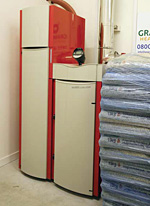 The new
woodfuel system provides constant background heating which serves
to keep the hall at a more reasonable temperature for users, as
well as protecting the fabric of the building against damp.
The new
woodfuel system provides constant background heating which serves
to keep the hall at a more reasonable temperature for users, as
well as protecting the fabric of the building against damp.
Originally pellets were delivered in bulk and manhandled into
the fuel store. For ease of use, the store has now been adapted to
accept blown pellet deliveries.
Wood fuel supply
Wood pellets are bought direct from a producer 30 miles away,
and delivered directly into the hopper via a pneumatic blower
attached to the delivery vehicle.
Blown truck loads often have a minimum delivery of about 5
tonnes. One tonne load bags delivered on a pallet are a cheaper way
to receive pellets, but require onsite handling machinery. Buying
in bags can cost up to twice the price of buying in bulk.
Dust socks or filters on the exhaust pipe or a layer of rubber
fixed to the back of wall of the pellet store will reduce dust
build-up through pellet break up.
Installation issues
The building was completely renovated in 2008. Wall and under
floor insulation were improved to ensure increased heat retention,
further helping to reduce heating costs and energy consumption.
The boiler and fuel store are located within the existing
storage area of the hall, this meant that no additional boiler
house construction was required.
Two universal fitting delivery pipes
into the fuel store are required to accept blown deliveries (the
second pipe allows excess air to escape).
Lessons learned
- It is important that the user fully understands the cleaning
requirements of the boiler to maintain output and reliability
- Delivery methods need to ensure dust creation is kept to a
minimum
- Secure a local fuel source as soon as the development is
conceived
- An internal fireproof hopper can add extra costs to a project -
make sure all costs are identified and included in the budget
- Carefully consider long-term delivery options for pellets.
Blown supplies are most like current fossil fuel deliveries, with
minimal input from the user
- Make sure your building is as energy efficient as possible,
thatproper due diligence is done and that you have a
comprehensiveunderstanding of woodfuel before planning a woodfuel
installation
- The availability of contractors locally to service the system
is key to minimising maintenance costs
- If your fuel hopper is not big enough to take a full load of
pellets and you wish to avoid buying individual bags, you are
dependent for re-supply on whoever happens to be delivering pellets
in your area and when
- It is difficult to predict when pellets will run out without
actually checking the fuel hopper
Facts and figures
Note: figures are approximate
| Building |
| Fabric |
Breezeblock and timber structure |
| Heating system |
| Boiler manufacturer/model |
Windhager BioWin 260 |
| Maximum boiler output |
25.9 kW |
| Fuel type |
Wood pellets |
| Fuel specification |
Moisture content: <10% (M10) |
| Delivery, storage and handling |
Hopper |
| Store capacity |
5 tonnes (8 m3) usually filled in 3 tonne deliveries |
| Back-up/top-up system |
None |
| Fuel consumption, costs and savings |
|
|
| Annual CO2 savings |
14 tonnes |
| Wood fuel cost |
£3200 in 2013 |
| Annual fuel cost saving at 2008/09 prices |
£1,000 |
| Payback period |
n/a - fully grant funded project |
| Installation cost and funding |
| Boiler system |
£24,000 |
| Funding source |
Scottish Community and Householder Renewables Initiative
(SCHRI), Global Environment Facility (GEF) |
| Funding support rate |
60% (SCHRI) 40% (GEF) |
Please note:
Whent his woodfuel system was installed, the UK Government
Renewable Heat Incentive (RHI) scheme did not exist. The RHI is now
available and commercial woodfuel heating installations can receive
payments based on metered heat produced for 20 years.
If this project were eligible for the RHI, it could generate up
to £2,236 of income per year, based on the maximum biomass tariff
of £0.086 per kWh, assuming 26,000 kWh of heat delivered per annum,
this income could be combined with any savings made over displacing
fossil fuels to give a very potentially attractive payback
period.
Projects installed pre July 2009, or that have received public
grants for their boilers from other sources (unless they have paid
them back) are not eligible for the RHI.